Why Every Dropshipping Store Needs Competitor Repricing

You are selling the same products as hundreds of other stores. Your price is the one thing you control completely. Here is how to make it work for you automatically.

Dropshipping is one of the most competitive retail models in e-commerce. You carry no inventory, but neither do hundreds of other stores selling the exact same products from the exact same suppliers. Your product photos are identical. Your descriptions are similar. Your delivery times are comparable.

So a shopper who finds your store through Google will almost certainly find three competitors at the same time. The question is not whether price matters in that moment. It obviously does. The question is how you stay competitive on pricing without burning hours on manual checks or accidentally selling below your supplier cost.

81%
of online shoppers compare prices before buying (Statista, 2024)
more likely to lose a sale when priced 5% above the lowest competitor
23%
average margin improvement reported by stores using automated repricing
daily price scrapes keep your data current around the clock

The Dropshipping Pricing Problem Is Unlike Any Other Retail Model

Most retail businesses have some natural buffer against competitor pricing pressure. They hold stock, negotiate exclusive deals, and build brand loyalty over time. A dropshipping store has very little of that working in its favour.

When you list a product sourced from AliExpress, a wholesale directory, or a local distributor, you can be certain that other stores are listing the same product right now. Some of those stores are already using automated repricing tools. They are reacting to market shifts within the same day. They are winning the Google Shopping placement you are not appearing in. And they are doing it without anyone manually checking a spreadsheet.

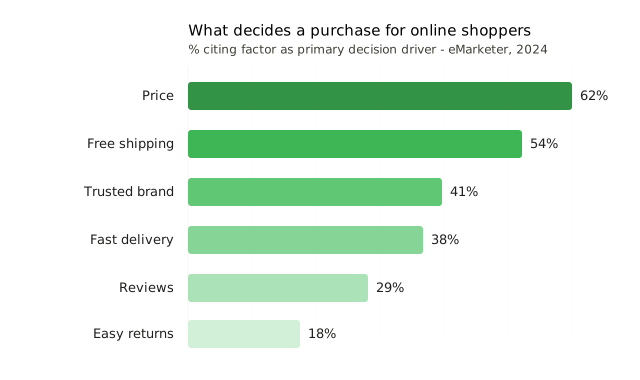
What decides a purchase for online shoppers

Your Supplier Cost Is Your Price Floor - And It Should Be Locked In Automatically

Every product you sell has a cost: the amount your supplier charges you. That number is your absolute floor. Sell above it and you make money. Sell below it and every order costs you.

Price Parrot lets you set your supplier cost as the minimum price within any repricing rule. This means no matter how aggressively a competitor drops their price, your store will never follow them below what you paid for the product. The repricing system holds at the floor rather than chasing a race to the bottom.

In practice this means: a competitor runs a clearance promotion and drops their price 40% overnight. Without a price floor, an aggressive repricing rule could drag your price down with them, turning a profitable product into a loss-maker before you wake up. With your supplier cost locked in as the minimum, the rule hits the floor and stops. You stay competitive up to the point where competition would cost you money, and no further.

Price Parrot Feature

PriceGuard - Protection Against Sudden Market Moves

Even with a price floor in place, sudden competitor price drops can cause problems if your rules react too aggressively. PriceGuard adds a second layer of protection by defining percentage-based thresholds. If a competitor moves outside that range suddenly, the system either freezes your price or switches to a backup rule rather than following the drop. You also receive an alert any time a product's price falls below cost, so nothing slips through unnoticed.

Manual Pricing Does Not Scale With a Real Catalogue

A dropshipping store can carry hundreds or thousands of SKUs across multiple niches. Monitoring competitor prices manually across that range is not inefficient, it is simply impossible to do accurately. You might check your top 20 products regularly. The other 300 drift out of competitive range quietly, either leaving margin on the table or losing sales to cheaper alternatives.

Price Parrot scrapes competitor websites multiple times per day using advanced anti-detection technology, so pricing data reflects the actual market at all times. Every product, every competitor, every repricing cycle, handled without manual effort on your end.

Google Shopping Rewards Competitive Pricing With Visibility

If paid or organic Google Shopping traffic is part of your strategy, and for most dropshipping stores it is, then your pricing directly affects your visibility, not just your conversion rate.

Google Shopping's algorithm favors listings priced competitively relative to similar products. A listing priced significantly above comparable offers tends to receive lower placement and reduced impressions, regardless of your ad spend. You can spend more on ads and still lose ground to a competitor who is simply priced better.

Staying within a competitive price band keeps your listings visible to shoppers who would never click through to compare in the first place. Repricing is, in this sense, also an advertising efficiency play. Every pound or dollar you spend on Shopping ads goes further when your listing is actually competitive on price.

What Happens Without Repricing: Three Common Scenarios

ScenarioWithout RepricingWith Price Parrot
Competitor drops price overnightYou stay overpriced, sales drop silentlyPrice adjusts automatically, you stay competitive
Competitor goes out of stockYou keep under pricing yourself unnecessarilyStock tracking detects the gap, you hold margin
Supplier cost increasesNo price floor means you sell at a lossFloor adjusts across all rules
Weekend traffic spikeStatic pricing misses peak conversion opportunityScheduled rule runs a timed promotion

Scheduled Pricing Gives Dropshipping Stores a Quiet Competitive Edge

Most dropshipping competitors are either pricing manually or running basic repricing rules with no time awareness. Scheduled dynamic pricing is a feature very few dropshipping stores are using, which makes it a genuine opportunity.

You can set rules that automatically lower prices on weekend afternoons when casual browsing peaks, apply a small discount during evening hours when purchase intent is higher, or run a recurring weekly promotion without touching anything manually. The rule activates on schedule and reverts when the window closes. For stores selling into multiple time zones, this kind of time-aware pricing can be particularly effective at capturing demand without permanently reducing margins.

Setting Up Takes Less Time Than You Would Expect

For Shopify stores, Price Parrot's dedicated app handles product import and price sync automatically. Products pull in, you configure your rules including supplier cost floors, and the system takes over. Price Parrot's Search Discovery feature also removes the most tedious part of setup: instead of manually hunting for competitor URLs product by product, it automatically searches the web to find matching competitor listings and presents them for bulk approval in one click.

For stores on Magento, OpenCart, CSCart, or custom platforms, the free REST API connects Price Parrot to any e-commerce stack. It is available on every plan, including the entry tier.

Price Parrot logo

The Bottom Line

Dropshipping stores that win over the long term are not necessarily the ones with the best supplier relationships or the cleverest marketing. They are the ones who execute consistently on pricing, and pricing is the one lever you can automate almost completely.

Your supplier cost protects your floor so you never sell at a loss. PriceGuard protects your margins from sudden market swings. Competitor scraping keeps your data current across every product. And scheduled rules let you run time-based promotions without lifting a finger.

The stores beating you on price right now are probably not checking competitors manually every morning. They have automated it. The decision is simply one of timing.

Find us on your platform

Shopify logo
Github logo
Composer logo
Woocommerce logo
Sello logo